

The Pause Before the Click
On social media, manners, and the strange compression of human response

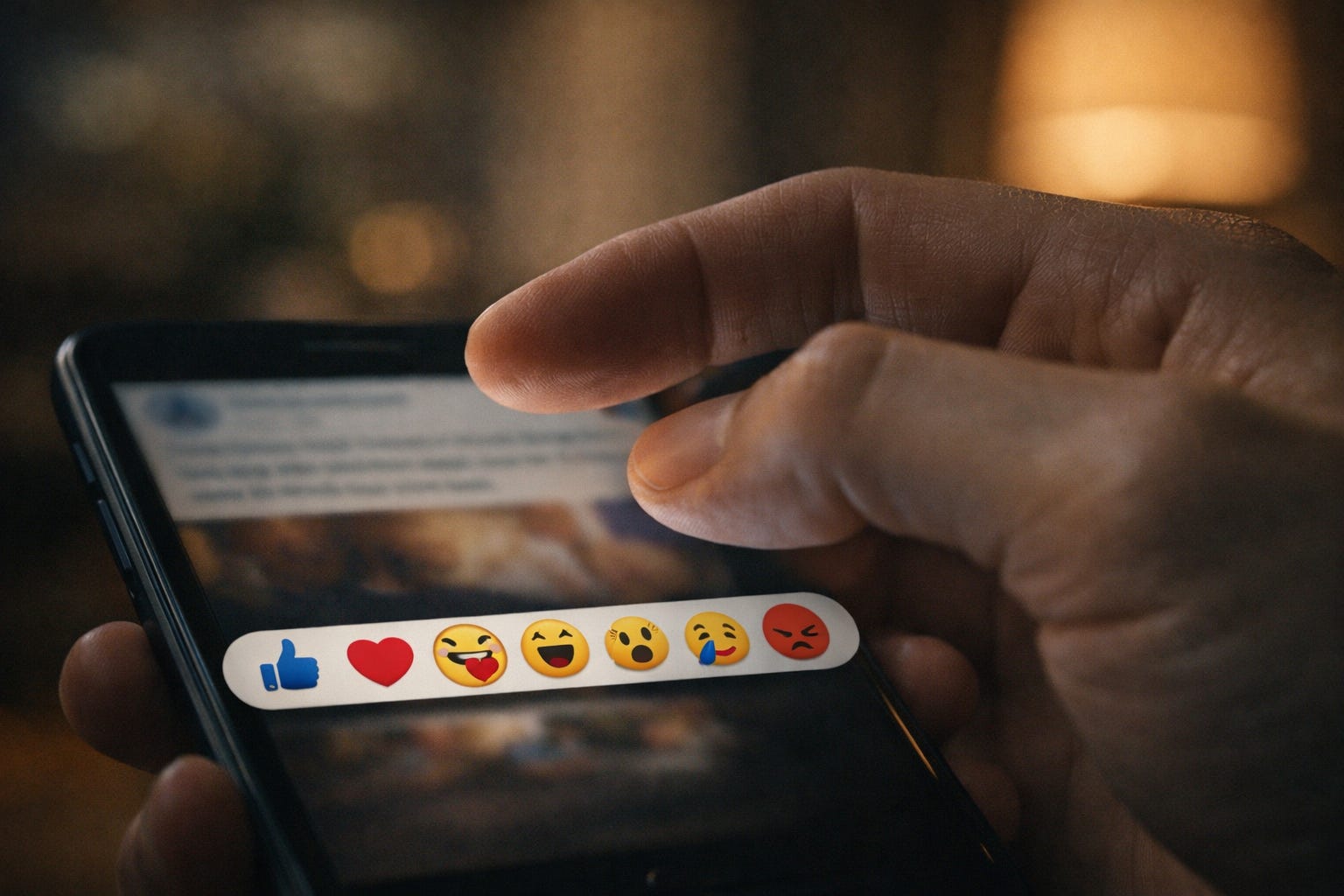
The absurd emotional vending machine at the bottom of every post
There is now a very modern kind of hesitation: your thumb hovering beneath somebody else’s post, trying to work out which tiny symbol is least wrong.
A friend says her father has died. Someone posts from a hospital bed with the forced brightness people sometimes adopt when the alternative is panic. Someone else announces a divorce, a redundancy, a diagnosis, a dog buried that morning under the lemon tree. And beneath it all sits the cheerful little reaction tray, ready for service. Like. Love. Care. Sad. On Instagram, the single overworked heart, drafted into duties well beyond its pay grade.
You pause because the thing itself does not fit the menu.
That pause is more revealing than it looks. It tells you that reacting is not the smooth, frictionless act the platforms pretend it is. If it were, you would simply click and move on. But often the question is not what you feel. Usually you do feel something. The question is what you are prepared to display. What will this look like to the person who posted it? What will it look like to everyone else? Does a heart mean sympathy? Affection? Support? Approval? Does “sad” seem thin? Does “love” look grotesque, as if you are endorsing the event itself, rather than trying to express care for the person inside it?
The silliness of the system does not weaken its power. It sharpens it. Human experience arrives in all its mess and contradiction, and the interface responds with a row of little pre-cleared stamps. Here is grief. Here is illness. Here is your old school friend’s engagement to a man you privately suspect is a mistake. Choose your symbol. Make it neat. Make it public.
And that is where the unease begins.
Because reactions are not really expressions of feeling. Not most of the time. They are instruments for managing implication. The platforms encourage the fantasy that you click because you feel. In reality, you often click because you are trying to control what your feeling will mean once it has been flattened into public form.
That is a different business altogether.
To feel sympathy is private. To register sympathy beneath a post is public, and public life has its own rules. Once the reaction leaves you, it stops belonging entirely to your intention. It enters a little economy of interpretation. It is read by the poster, by mutual friends, by colleagues, by family, by semi-strangers, and by the machine itself, which counts everything and understands nothing. A reaction is not merely emotion made visible. It is a small statement about where you stand.
That is why the same symbol can do wildly different jobs depending on context. A heart might mean admiration, pity, encouragement, solidarity, politeness, or simply I saw this and did not want to leave you hanging there in silence. “Sad” might mean sympathy, grief, moral disappointment, or general despair at the state of the world. “Haha” can mean actual amusement, affectionate laughter, disbelief, contempt, ridicule, or the very online pleasure of seeing something so stupid it becomes entertaining. Even the humble “like” long ago stopped meaning straightforward approval. Very often it means no more than acknowledgment with a pulse.
So the real work is not emotional expression. It is translation. You take some dense and private response, and compress it into the least misleading public shorthand available.
Or try to.
Facebook at least likes to pretend there is such a thing as nuance. It offers a small emotional paint chart: like, love, care, haha, wow, sad, angry. Compared with Instagram’s single heart, it can almost seem sophisticated. But the extra options do not solve the problem. They just give you more ways to be misunderstood.
“Love” might mean affection for the person, strong agreement, ceremonial warmth, or simply a more emphatic version of I’m here. “Care,” that strangely corporate little invention, is often just “love” in a cardigan. “Sad” appears clear until you use it and realise it is carrying several jobs at once. “Angry” can mean moral clarity, personal upset, exhaustion, or I saw this and refuse it but cannot bear to explain why. And “haha” is basically an unexploded device. It can swing from warmth to cruelty in an instant.
Even “like,” the oldest workhorse of the internet, is rarely simple now. Often it means: I saw this. I am marking my passage through. I do not quite know what else to do here, but ignoring it felt worse.
So Facebook’s great promise of emotional precision turns out to be mostly theatre. The icons do not carry fixed meanings around like neatly labelled parcels. The platform supplies the symbols; the users do the interpretive labour.
Instagram takes the opposite approach. It gives up on nuance almost immediately and hands everything to the heart. Holiday snaps, dead parents, weddings, miscarriages, gym progress, black-and-white grief portraits, expensive pasta, political slogans, hospital updates, long captions about burnout: same heart. Different weather.
The heart stopped meaning love years ago. Now it means something vaguer and more ceremonial. I’m here. I’ve seen this. I won’t leave you unanswered. In that sense it is not really a declaration of feeling at all. It is closer to a nod. A touch on the sleeve. A murmur of yes, yes, I see you there.
That vagueness can sometimes feel gentler than Facebook’s clumsy specificity. Facebook forces you into categories. Instagram lets the heart stay hazy. It allows the other person to interpret it generously: warmth, sympathy, solidarity, acknowledgment. But that mercy comes at a price. Once one symbol is asked to cover everything, it loses texture. Celebration and consolation begin to look uncomfortably alike. Joy and grief receive the same emblem. Delight and sympathy share a badge.
The system only works because everyone tacitly agrees not to take the symbol too literally.
And that unspoken agreement is doing an extraordinary amount of work.
It also explains something else: why so many people choose not to react at all.
The platforms train us to treat visible reaction as evidence of care and silence as evidence of something colder. Indifference. Distance. Passive aggression. Judgment. But that is often much too crude. A great many people do not fail to react because they feel too little. They fail to react because they feel too awkwardly, or too much, to trust the available forms.
Anyone who has stared at a difficult post knows the sensation. None of the options is exactly wrong, but none seems equal to the thing. A heart feels generic. “Sad” feels public and thin. “Love” carries the wrong temperature. A comment risks cliché or intrusion. So you do nothing, not because nothing is there, but because the machinery of public response feels beneath the moment.
This happens most often when real life breaks through the platform without proper smoothing. Grief. Illness. Family trouble. Money trouble. The pain has not yet been translated into the polished grammar of online disclosure. The post still has too much reality clinging to it. And in those moments the reaction menu can feel embarrassingly inadequate, like someone arriving at a house fire with a decorative napkin.
So people step sideways. They send a private message. They make a note to call. Or they remain silent because even private language feels intrusive. The public record shows absence. The emotional reality may be anything but absent.
That is one of the quiet distortions of these systems. They privilege legible care over actual care. They count the visible gesture and have no way of measuring everything that happens offstage: the message sent later, the concern carried around for two days, the careful decision not to turn someone else’s pain into a little public display of one’s own sensitivity.
And yet the whole thing remains bearable because users keep supplying the nuance the platforms cannot.
This is the invisible labour of social media. We are constantly interpreting one another more generously than the interface deserves. We know that a heart under a bereavement post does not mean delight. We know that “sad” beneath a diagnosis is standing in for something more human than the icon itself can carry. We know that a clumsy “like” may not signal coldness at all, but uncertainty, haste, or simple reluctance to let the post pass unanswered.
In other words, we spend a remarkable amount of time translating bad interface language back into usable human meaning.
And we do it almost automatically. That is the striking part. Social media survives not because the tools are elegant, but because users repeatedly repair them. They soften one another’s awkward signals. They overlook literal meanings in favour of likely humane ones. They grant each other the mercy they hope to receive themselves one day, when they choose the wrong icon, or no icon, or one whose tone is half a degree off.
Charity, in that sense, is part of the infrastructure.
But that charity is uneven. It tends to hold in the presence of personal suffering and collapse in the presence of politics.
Under grief, illness, bad luck, or ordinary human difficulty, people are usually fairly generous readers. A heart means sympathy. A stock phrase is tolerated as an attempt at care. A slightly awkward response is forgiven because vulnerability makes people softer.
Politics does the opposite. Politics turns everyone into an amateur semiotician.
A heart is no longer warmth; it is endorsement. A laughing reaction is no longer disbelief; it is mockery, tribe, declaration. A repost is not circulation but alignment. Even silence becomes suspicious. Why did you like that but not this? Why say nothing now? Why react to the wedding, the dog, the diagnosis, but not to the post that mattered to me politically?
Under ideological pressure, reaction systems stop being social niceties and become loyalty tests.
No platform made that clearer than Twitter, or X, which understood earlier than most that reacting online is often less about feeling than about force. On Twitter the distinction between liking and retweeting mattered because the distinction between approval and amplification mattered. A like could still be deniable. A retweet moved the thing. It gave it air, reach, momentum. A quote-tweet framed it, weaponised it, mocked it, enlisted it. It said not merely here is a post, but here is how you are meant to read it.
Twitter did not bother much with the sentimental fiction that clicks are just little pulses of feeling. It was much more honest, and therefore much harsher, about the fact that they are often moves. A move in relation to the post, the audience, the tribe, the atmosphere. A move that can be counted, measured, ratio’d, and publicly judged.
Once you start thinking of reactions as moves rather than feelings, a lot of online life looks different. The softer language falls away. People are not merely expressing themselves. They are maintaining ties, signalling presence, tending to bonds, managing affiliations, smoothing over distances, keeping relationships faintly alive through low-cost visible gestures.
This is not entirely bleak. In ordinary life we do versions of this all the time. We nod. We send the card. We say congratulations with precisely calibrated enthusiasm. We ask after the parent. We laugh slightly more warmly than the joke deserved. Social media did not invent those rituals. It formalised them, simplified them, and made them public.
The reaction button is simply the latest shorthand in the old human language of maintenance.
That is why the individual click feels trivial, yet over time the pattern of clicks can feel charged. One starts to notice who always reacts and who never does. Who arrives warmly and who perfunctorily. Who appears for grief but not for joy. Who endorses the polished milestone but vanishes when things get messy. The tiny gestures begin to sketch a map of social attention. Not a perfectly fair one, but enough to sting.
That is where reactions start to feel faintly melancholy. They reveal how much of modern social life is now maintained through brief, low-cost marks of acknowledgment. Enough to stop the relationship evaporating. Not always enough to count as relationship in the older sense.
Still, there is something human in the effort. Even now, inside all this bad machinery, people keep trying to mean kindly through inadequate forms. They are improvising tact inside systems with very little native understanding of tact. They are trying to register that another person’s life has reached them without making too much, too little, or the wrong thing of their response.
Perhaps that is why the small pause beneath the post matters more than it seems to. That hesitation is not trivial. It is the last trace of proportion. The brief recognition that what is being asked of us – choose a symbol, make it public, move on – is not quite equal to the mess and weight of human life, and never will be.
The platforms would prefer that we react neatly.
What survives in the pause is the stubborn knowledge that other people are not neat.
Colophon
Listening to the old human problem in its newest, smallest form.
Reading the moral weather at the bottom of the post.
Written while thinking about tact, charity, and the strange fact that so much of social life now passes through icons designed to mean far less than we ask of them.