

The Territory Within
An imagined life of the inward child – slightly apart, more observer than participant, and looking for the inner map school never thought to provide.

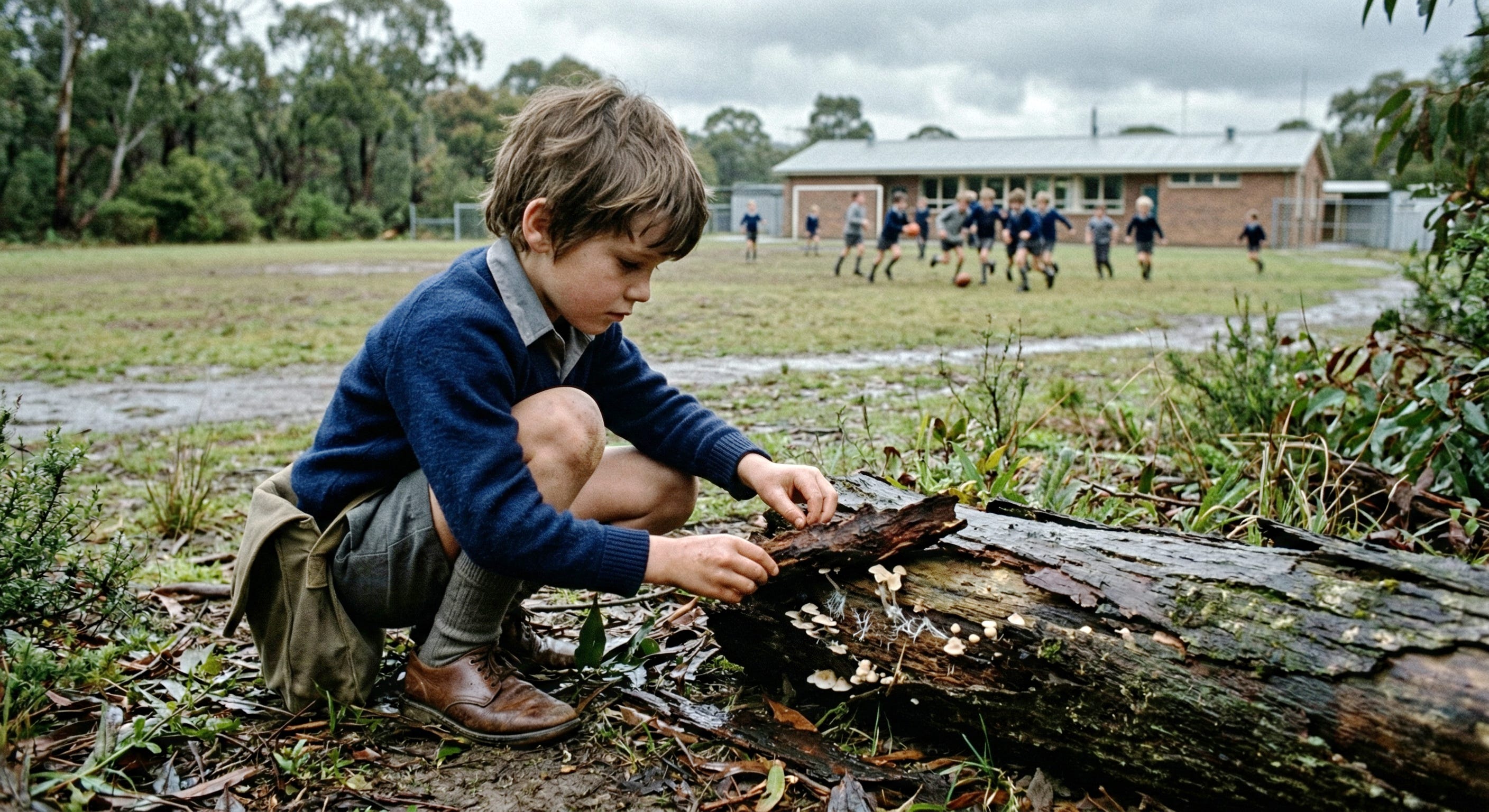
This is a composite portrait of those who stood near the noise, but never fully in it.
Some kids seemed to know how to be in the world from the first day of school.
They hit the playground as if it was theirs by birthright. They knew how to join in, how to talk over each other without offence, how to make a joke, how to take one, how to be part of the racket of it. They moved through all that noise as easy as magpies through a paddock.
I never quite did. Not that I was miserable. I wasn’t. I had mates, or enough mates. I wasn’t tormented. I wasn’t eating my lunch alone behind the shelter shed like some tiny exile. I could do the work. I could answer questions. I could kick a footy badly enough to pass as normal. From the outside I probably looked much like any other boy. But inwardly was another story. Inwardly I had the feeling of standing just off to the side of things, as though everyone else had turned up with some natural ease I’d somehow missed.
It wasn’t sadness exactly. More a kind of drift. A feeling that I wasn’t fully planted in my own life. That I was there, certainly, but not in the same way other kids were there. Some part of me always seemed to be hanging back, watching, trying to work out the rules of a game everyone else had already started.
And school, which was meant to explain the world, explained none of it.
School had answers for everything except the things that mattered.
It could tell you where the Murray started and where it ended. It could tell you what a verb was, how erosion worked, what Captain Cook did or didn’t do, why the Romans built roads, how to borrow from the tens column. It could tell you all sorts of things that were probably useful.
But it had nothing to say about what it felt like to be alive inside yourself. Nothing to say about why a child might sit in a room full of other children and feel, not frightened, not unhappy, but somehow unmoored. Nothing to say about shame arriving out of nowhere, or the way a mind could run ahead of you and leave you puffing after it, or why some days the world felt close and bright and other days it felt as if you were looking at it through flyscreen.
What stayed with me most was the silence around it. Not that I felt these things, but that nobody seemed to speak of them. The grown-up world had rules about everything else. Work hard. Be polite. Don’t answer back. Tuck your shirt in. Try your best. Get on with it. But on the subject of the inner life – the mess of it, the fear, the fantasies, the sudden plunges, the odd moments of stillness and wonder – there was almost nothing. It was as if everyone had agreed this was the one country we all lived in but no one would draw a map of.
Years later, reading Stephen Batchelor, I felt that old jolt of recognition. He writes of sitting in school and wondering why no one ever talked about what it was actually like to be a person from the inside. That landed hard because it was so plain and so true.
There it was at last, said straight: the thing I had felt all through childhood without hearing it named.
What mattered even more was the way he described solitude. Not as loneliness. Not as retreat. Not as some noble isolation for saints and artists and difficult men in huts. He meant something steadier than that. He meant learning how to be by yourself without being endlessly shoved around by whatever rose in you – fear, shame, wanting, anger, old hurts, all the rest of it. He called it creating “an inward autonomy within ourselves.” That is a good phrase because it takes solitude out of the realm of mood and puts it in the realm of practice.
If that clue came to me at all when I was young, it came sideways.
It came outside. Not in any grand poetic way. I wasn’t out there communing with nature. Mostly I was walking because it was easier than sitting at home with that same old restlessness buzzing around me, and easier than the crowded feeling school could leave behind. So I wandered. Across paddocks. Along creek banks. Through bits of scrub behind the oval. Into the damp shade where the ground held its cool even on hot days.
And there, under bark and in rotten logs and in the dark wet leaf litter, was another world.
Not a dramatic one. Not bright. Not clamouring for attention. Just quietly there. Little shelves and knobs and cups growing out of decay. Pale threads running through softened wood. Things the colour of old cream, ash, rust, tobacco stain, bruised peach. Tiny growths pushing up from places most people never looked at twice.
I don’t know why I kept stopping for fungi, only that I did. There was something about them that made immediate sense to me before I had any language for why. Maybe because they were easy to miss. Maybe because they didn’t seem to care whether they were seen or not. Maybe because the bit you could see was obviously only a small part of what was really there.
That felt true in a way a lot of other things didn’t.
The mushroom itself was only the brief appearance. The real business was elsewhere – under the ground, inside the dead wood, through roots and soil and whatever damp dark life was busy turning one thing into another. That made more sense to me than a lot of what I was being taught.
By then I had already begun to suspect that the visible part of life was never the main part. Not with people, anyway.
The loud boy in the yard, the teacher losing patience, the father home from work and saying very little, the mother staring out the window for a second too long before turning back to the sink – every one of them had some other life going on underneath what could be seen. Worries. Shame. Old injuries. Private hopes. Resentments. Fears. A whole hidden system running under the surface.
The fungi seemed to say the same thing. That what mattered most was often out of sight. That what looked like rot might also be transformation. That life was busy in places the eye had not been trained to notice. That hidden did not mean empty.
I don’t want to overdo it. I wasn’t some solemn little bush philosopher getting life lessons from mushrooms. I was just a boy who found it easier, some days, to crouch beside a fallen log than to throw himself into the noise of other people. But even so, I think those hours taught me something school did not.
They taught me that not everything real announced itself. They taught me that paying attention could settle something in you. They taught me that hiddenness was not the same as failure.
That was the part of Batchelor I knew at once. Not the doctrine. Not even the Buddhism as such. The seriousness with which he treated the inward life. The idea that solitude is not simply being alone – anyone can be alone and still be in a complete uproar inside themselves – but learning, little by little, not to be yanked around by every feeling that rises.
Because what had been hard when I was young was not only other people. It was also my own mind. Or maybe not my mind exactly, but my helplessness in the face of it. A mood came and I was inside it. Shame came and I was under it. Anxiety came and I followed where it led. I had no practice for any of this. No grammar. No map. I thought the feelings themselves were the problem. I didn’t yet understand that maybe the problem was not knowing how to meet them.
That is why I like Batchelor’s idea that solitude is something you cultivate. Cultivate is a good word. It takes the glamour out of it. Makes it sound like work, which it is. Or gardening, which is also work, only slower and with more failures. It suggests that inward steadiness is not something bestowed on a lucky few. It is something you make, bit by bit, by paying attention. By noticing what rises in you before it seizes the wheel. By learning that every feeling is real, but not every feeling gets to run the day.
I find that hopeful, because it means the inward life is not just something that happens to you. It can be tended. Not controlled exactly – that is too strong, and probably false – but tended. Sat with. Watched. Given less power to throw you about. You can learn, if only imperfectly, to stay put while the weather passes through.
And the strange thing is that this sort of solitude does not pull you away from other people. Batchelor argues the opposite: that becoming less reactive makes friendship, marriage, ordinary company more possible, because you stop asking everyone around you to manage the storm inside your own head.
That seems right to me. The people easiest to be with are rarely those who have escaped inward struggle. They are the ones who have stopped making it everybody else’s burden.
Looking back now, I do not feel sorry for the boy I was. Or not much. Plenty of children feel themselves standing just outside things. Plenty suspect there is some missing explanation everyone else has been let in on. That is not tragedy. That is just one of the ways a life starts. But I do feel for him a little. He was looking for clues wherever he could. He was trying to work out whether the hidden life inside him was a flaw or simply a place he would have to learn to live.
Maybe that is all any of us are doing.
The fungi had it right. What shows itself is only ever a fragment. Under the brief appearance of things is another life entirely – quieter, slower, mostly invisible, but doing the real work. Maybe solitude is something like that. Not turning away from the world. Not giving up on other people. Just learning how to tend what is underneath. Learning how to live from that deeper place instead of being dragged around forever by the surface chop of things.
That seems to me now no small task. It may be most of the task.
Colophon
I came to this piece while doing something dull and necessary: moving old Apple photos across to Google.
Instead of finishing the job, I found myself wandering through school pictures and class photos, looking at faces I had not thought about in years. Some came back instantly. Others didn’t.
And somewhere in that slow trawl through the archive I began wondering about the lives that followed – what hardened, what deepened, what got lost, what was already taking shape behind those expressions.
This is not a personal history so much as a composite portrait, but it owes something to that afternoon and to the feeling that every child carries an inner territory mostly hidden from view.
Inspired by a rereading of Stephen Batchelor’s The Art of Solitude and Maria Popova’s (as ever) brilliant treatment of the book at The Marginalian.
I got your message, and I went to reply this morning but I can't find it - what app did you use to send it?